


Keywords
As drive shaft manufacturers, we get asked one question more than almost anything else: “So, where exactly is the drive shaft?”
At first glance, it seems like a simple question. But the truth is, the answer changes depending on what you’re driving. We believe that the more our customers understand about their vehicle’s anatomy, the more they’ll appreciate the engineering and precision we put into every part we build.
It’s not enough for us to just say, “It’s under the car.” We want to give you the full breakdown of where it sits, how it changes based on your drivetrain, and how you can spot it yourself.
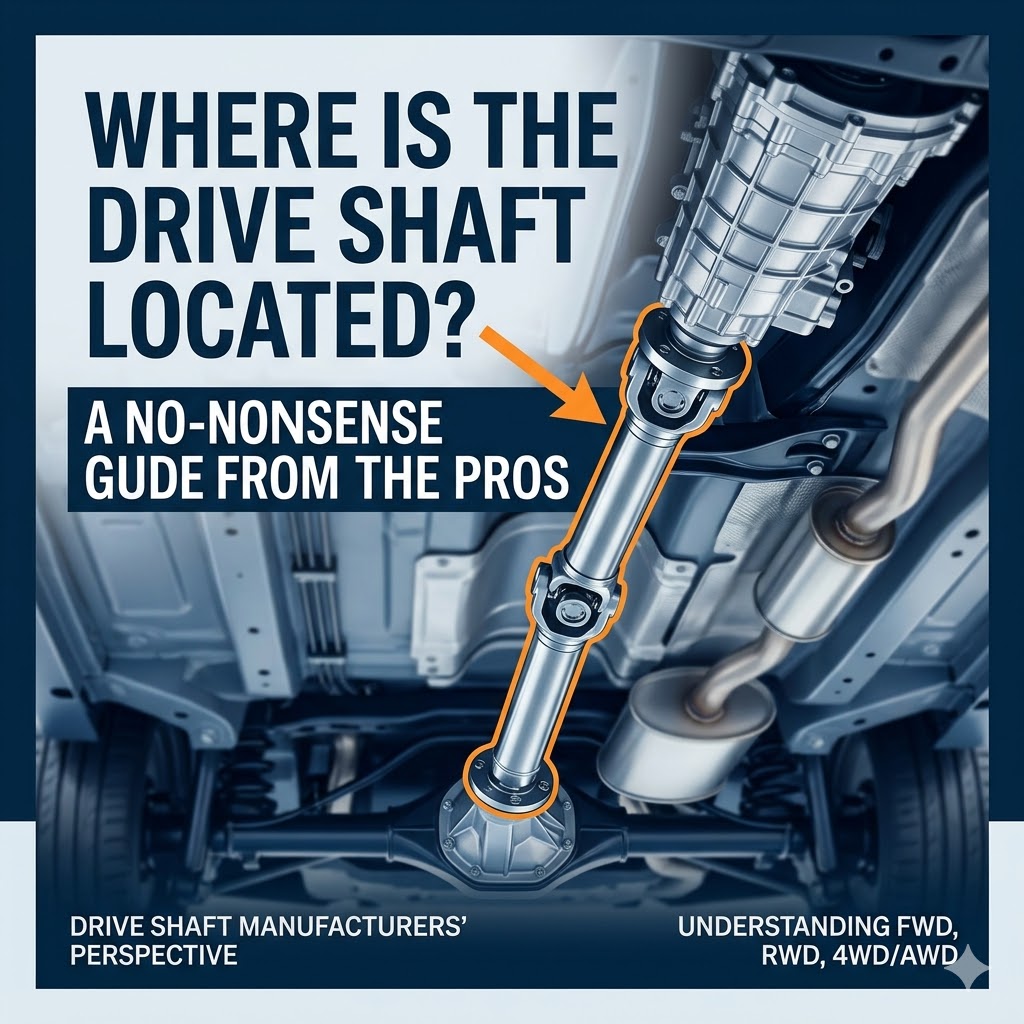
The Short Answer: Where is it, generally?
No matter the vehicle, the drive shaft has one job: getting power from the engine and transmission to the wheels.
To do that, it’s always located on the underside of the vehicle, positioned between the transmission (or transfer case) and the axle it’s powering. Think of it as the “heavy-lifting middleman” of your car’s powertrain. In most cases, it looks like a long, sturdy metal tube running down the center of the car.
Location by Drivetrain (The Manufacturer’s Perspective)
This is where things get specific. Depending on the setup, we manufacture different types of shafts to fit different spaces.
1. Front-Wheel Drive (FWD) – The “Half-Shaft” Setup
In an FWD car, you won’t find a single long tube running front-to-back. Instead, we manufacture two shorter shafts known as half-shafts or CV axles.
- Where it is: Right behind the front wheels. They connect the transaxle (the combo of transmission and differential) directly to the front wheel hubs.
- What it looks like: Sturdy rods featuring flexible rubber “boots” (CV joints) at each end.
- Pro Tip: If you peek behind your front tires, those rods with the accordion-style rubber covers? Those are our half-shafts at work.
2. Rear-Wheel Drive (RWD) – The Classic Long Shaft
This is the classic design most people picture. It’s one of our high-volume categories, built for high-speed rotation and durability.
- Where it is: It runs straight down the “spine” of the car, connecting the transmission at the front to the differential on the rear axle.
- What it looks like: A long, cylindrical metal pipe. For longer vehicles like trucks, we often include a center support bearing in the middle to keep things stable and vibration-free.
- Pro Tip: Crouch down and look under the middle of the truck. If you see a long metal tube heading toward the back wheels, that’s it.
3. 4WD and AWD – The Dual-Shaft Powerhouse
For vehicles that need power at all four corners, the setup gets a bit more complex. We usually manufacture two separate shafts for these rigs.
- Where they are: One shaft runs from the transfer case to the rear differential, and a second, usually shorter one, runs forward to the front differential.
- What it looks like: Two independent metal tubes pointing in opposite directions from the middle of the vehicle. These are built extra tough to handle off-road stress.
- Pro Tip: If you crawl under an SUV or Jeep, you’ll likely see these two shafts working in tandem to split the power.
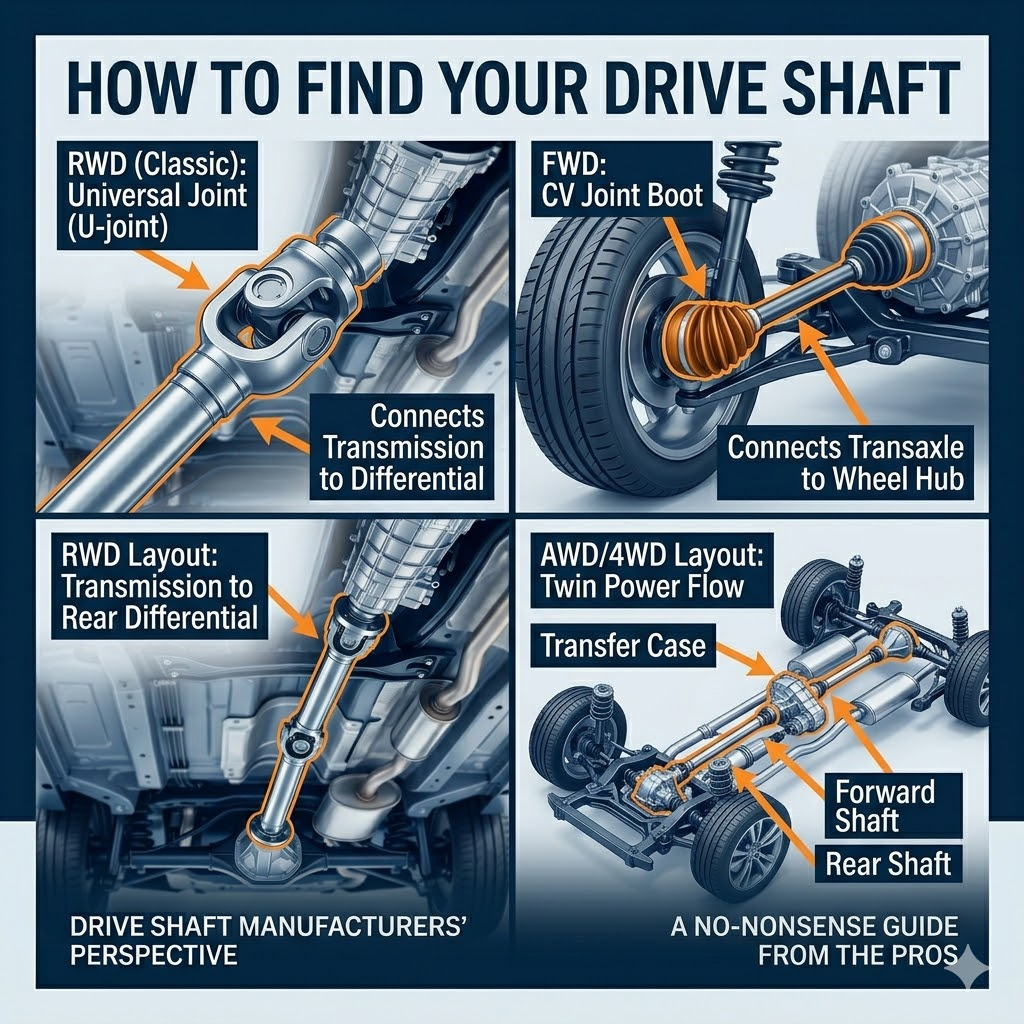
How to Spot Your Drive Shaft
Want to find the shaft we built for your vehicle? Just follow these steps:
- Safety First: Make sure the engine is off, the parking brake is pulled tight, and you’re on flat ground.
- Look Low: Crouch down by the side of the vehicle and look toward the center of the underbody. On trucks and SUVs, the long tube is hard to miss.
- Check the Wheels: For FWD cars, look behind the front tires for those shorter rods with rubber boots.
- Find the Joints: Look for the Universal Joints (U-joints) or CV joints. These are the “elbows” of the shaft—and they’re the hallmark of a professional drive shaft assembly.
Why Do We Put It There?
You might wonder: “Why the underside? Why that specific spot?” As manufacturers, every inch of placement is calculated.
- Direct Power: We aim for the shortest, straightest path between the transmission and the wheels to minimize power loss.
- Balance: Keeping the shaft centered and low helps maintain the car’s stability and reduces wear and tear.
- Saving Space: Tucking it under the floor keeps the cabin and cargo areas spacious for you.
- Keeping it Cool: Being under the car allows airflow to naturally cool the shaft during long hauls, which is a massive boost for durability.
Final Thoughts
So, where is the drive shaft? It depends on what you’re driving, but it’s always strategically placed to deliver the most efficient power possible.
Whether it’s a compact FWD commuter or a heavy-duty 4×4, our design logic remains the same: precision, durability, and perfect fit. When you see one of our shafts under a vehicle, you’re looking at years of engineering meant to keep you moving smoothly.
Ready to upgrade your fleet or need a custom build that stands up to the pressure? Reach out to our team today and let’s get your project moving in the right direction.