


In The Article
If the drive shaft is the backbone of your vehicle, the connection bolts are the tendons holding everything together. They might be small, but they carry the literal weight of your engine’s torque. When these bolts fail, your drive shaft doesn’t just stop working—it can come flying off.
Today, we’re going to get into the nitty-gritty of drive shaft bolt specs. Whether you’re a mechanic or a DIYer, getting these numbers right is the difference between a smooth ride and a catastrophic breakdown.
1. Thread Dimensions: Why “Close Enough” Isn’t Enough
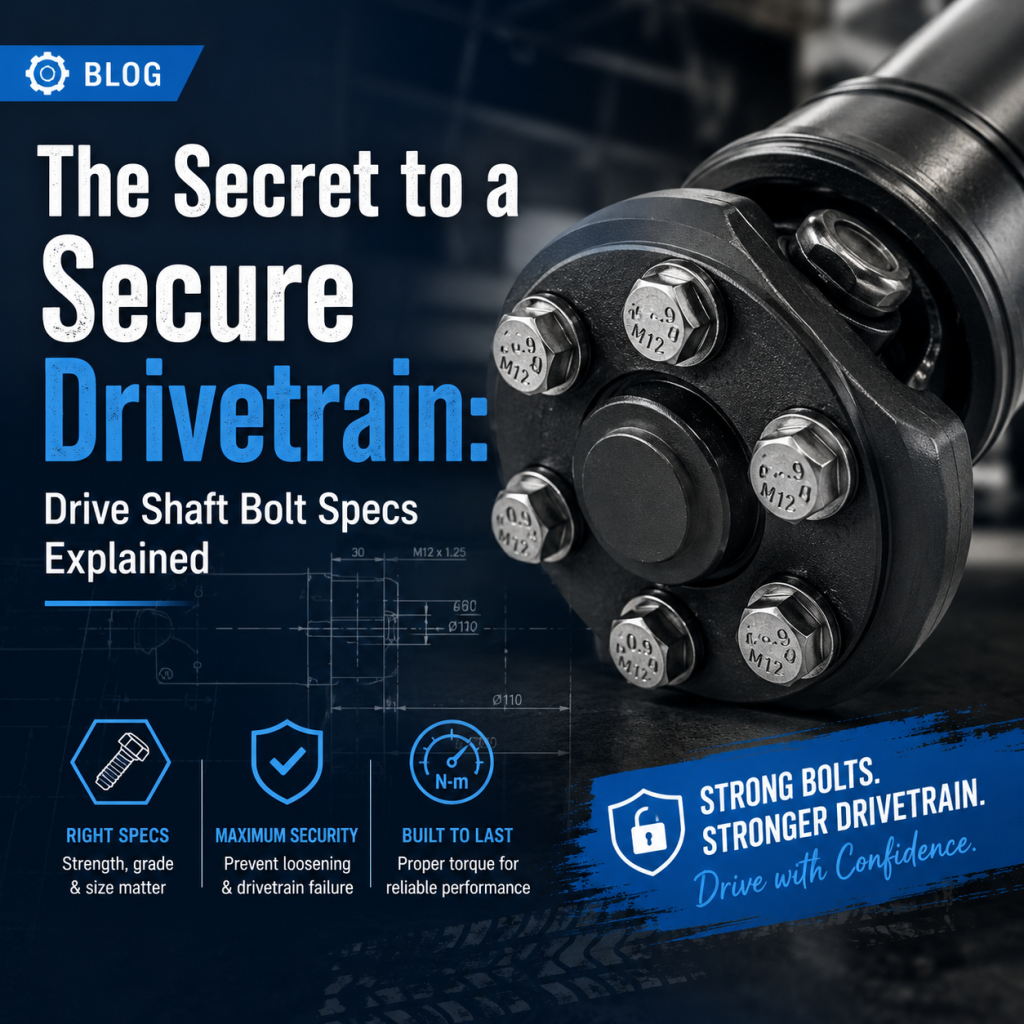
Most drive shaft bolts live in the metric world, usually ranging from M8 to M16. However, the “pitch” (the distance between thread peaks) is where most people trip up. If the pitch doesn’t match perfectly, you’ll cross-thread the bolt, which ruins the structural integrity before you even leave the garage.
- Japanese Manufacturers: You’ll often see M12×1.25 threads (12mm wide with a 1.25mm pitch).
- American Manufacturers: They often stick to the Imperial system, like 1/2″-13 UNF (about 12.7mm wide with 13 threads per inch).
In the world of high-precision engineering, these threads aren’t just cut; they’re often rolled. This process makes the threads stronger and less likely to crack under the constant vibration of a spinning drive shaft.
Quick Reference: Common Thread Specs
| Vehicle Origin | Common Bolt Size | Thread Pitch/Count |
| Japanese (Toyota, Honda) | M12 | 1.25mm (Fine) |
| American (Ford, GM) | 1/2″ | 13 TPI (UNF) |
| European (BMW, VW) | M10 or M12 | 1.5mm (Standard) |
2. Length and Shank Design: It’s About the Fit
You can’t just grab any bolt from the hardware store bin. Drive shaft bolts usually range from 20mm to 50mm in length. Why the specific range? Because you need enough “meat” for the threads to grab, but not so much that the bolt hits a bearing or blocks a lubrication channel.
- The BMW Example: A BMW 3 Series typically requires a very specific 30mm bolt.
- The Shank: Many bolts feature a “stepped” or unthreaded shank. This part of the bolt is designed to fit perfectly into the bore of the drive shaft flange. It balances the rotational stiffness of the assembly, making sure the bolt doesn’t shear off when you stomp on the gas.
3. Strength Grades: Choosing Your “Weightlifter”
This is where things get serious. You wouldn’t use a plastic toy to tow a trailer, and you shouldn’t use a low-grade bolt on a drive shaft. These bolts are made from alloy steels like 40Cr or 35CrMo, which are heat-treated to handle the “twist” (torque) of the engine.
Bolt Strength Cheat Sheet
- Grade 8.8: The standard. It has a tensile strength of 800MPa. Perfectly fine for your average sedan or family car.
- Grade 10.9: The heavy-hitter. With 1000MPa of strength, this is what you’ll find in commercial trucks and big SUVs.
- Grade 12.9: The extreme athlete. This is reserved for off-roaders and performance builds where the torque levels are through the roof.
Pro Tip: Look at the head of the bolt. If you don’t see “10.9” or “12.9” stamped on it, it might not be strong enough for a high-torque application.
4. Torque Specs: The “Goldilocks” Principle
Tightening a drive shaft bolt is a balancing act. Too loose? It’ll vibrate out. Too tight? You’ll stretch the metal until it snaps. This is why a torque wrench isn’t optional—it’s a requirement.
Common Torque Values to Keep in Mind:
| Bolt Diameter | Recommended Torque (N·m) |
| M10 | 45 – 60 N·m |
| M12 | 73 – 90 N·m |
| 1/2″ (Imperial) | 130 – 160 N·m |
Maintenance Protocol: Don’t just “set it and forget it.” Especially on trucks or vehicles that go off-road, these bolts should be inspected periodically. Look for “backing out” (loosening) or signs of rust and metal fatigue. If you see a bolt that looks stretched or has “waisted” threads, replace the whole set immediately.
Drive shaft bolts are the final link in your vehicle’s power chain. Using the wrong thread, a weak grade, or an “eyeballed” torque setting is a recipe for a very expensive—and dangerous—disaster.
Need hardware that won’t let you down? At HangHuJX, we specialize in precision-engineered drive shaft components that meet or exceed OEM standards. From heavy-duty U-joints to high-tensile connection assemblies, we build parts that handle the pressure so you don’t have to.